25 June 2012

Scientists warn, politicians ignore

The Global Network of Science Academies, representing 105 science academies around the world, issued a press release last week highlighting what they referred to as "two of the most profound challenges to humanity—population and consumption," and went on to call for "urgent and coordinated international action to address them." They emphasized that, "current patterns of consumption, especially in high-income countries, are eroding the planet’s natural capital at rates that are severely damaging the interests of future generations, and should consequently and urgently be reduced." They offered a range of actions that need to be taken to deal with the challenges.

They went on to mention the "extraordinary opportunity" that policymakers had at the Rio+20 international summit "to take the sound, evidence-based advice of their own academies of science as they make decisions that will affect the future of the planet.”

So, did the policymakers of the 192 countries represented at Rio take the advice of their science academies? One might hope so considering carbon emissions have increased 40% and biodiversity loss has risen 30% in the 20 years since the first Rio conference. But such was not the case. On Friday, the delegates did little more than  rubber-stamp a draft agreement that essentially provides no new commitments to fight climate change.

Most of the G20 leaders didn't even bother to show up at the conference. France's new president, Francois Hollande, was there, but Barack Obama, David Cameron, Angela Merkel and, needless to say, Stephen Harper were no-shows. Their excuse is the deepening financial crisis, but that's a bit weak. They could have, if they were interested, taken a flight from Los Cabos to Rio after the G20 conference ended on Tuesday. 

Canada's delegation was there making its usual mischief, working to weaken commitments on biodiversity of oceans and fossil fuels and blocking financial commitments to developing countries. When Peter Kent, Canada's Environmental Minister, says he was "very happy, very satisfied" with the outcome you know it was a failure.

Ironically, by ignoring the environmental crisis, world leaders are threatening the long term health of the global economy, precisely the thing they claim to be concerned about.

"We are living beyond the planet's means. That's scientifically proven," says Gisbet Glaser of the International Council for Science, "We're now at a point in human history where we risk degrading the life support system for human development." Do our leaders not recognize the futility of dealing with current economic issues while allowing life support systems for human development to degrade? Are they blind to the big picture? I'm becoming afraid to ask the question.

22 June 2012

Bully for the nuns

I'm no fan of the Roman Catholic Church, or organized religion generally, but when the folks in black do a good deed, I'm prepared to recognize it. And the good sisters of Network, a Washington-based Catholic social justice group, are doing a good deed indeed. They have initiated a nine-state bus tour protesting proposed federal budget cuts, saying they felt called to show how Republican policies are affecting low-income families.

The nuns' trip was inspired by Rep. Paul Ryan, a Republican from Wisconsin, the architect of the House-passed budget, who said that Catholic social teachings inspired the cutbacks he proposed. The cutbacks would decimate many programs run by sisters.

The Vatican has asked U.S. bishops to look at Network’s ties to another sisterhood, the Leadership Conference of Women Religious, the organization that represents most American nuns. It has accused Women Religious of focusing too much on economic injustice while failing to promote the church’s teachings on abortion and same-sex marriage, and has ordered American bishops to carry out a full-scale overhaul of the organization.

The good sisters of Network seem unfazed by the Vatican's bullying and persist in their advocacy for the less fortunate. Unlike some of their Catholic brothers, such as Rep. Paul Ryan, they seemed to have an ear for Jesus's message.

City charters—progress for Calgary and Edmonton?

The municipal level of government is the orphan of our political system. Cities are, under the Constitution, creatures of the provinces. In 1867, making municipalities wards of the provinces may have made sense; most people lived on farms or in small towns serving the farms. Eighty per cent of Canadians were rural. Today, eighty per cent are urban. Canada is part of the greatest human migration in history, a worldwide march from the country to the town. Over half the population of Alberta now lives in two cities: Calgary and Edmonton.

In an attempt to modernize their relationship, the two cities signed an agreement this week with the provincial government that will lead to city charters. Edmonton Mayor Stephen Mandel says talks will first define "who does what"—and then figure out where the money will come from to pay for it. Municipal Affairs Minister Doug Griffiths said he hopes a draft form for the new arrangements will be ready by spring 2013.

Charters are not new for Canadian cities. Montreal, Toronto, Winnipeg and Vancouver, among others, have them. Although charters offer a certain independence, they don't change the fact that cities are still constitutionally subservient to provinces. Provincial governments have the right to bestow authority on cities, and the right to take it away. A charter granted to Halifax in 1841 was extinguished on April 1st, 1999—April Fool's Day—by the provincial government of the day.

So charters may enhance Calgary and Edmonton's abilities to govern themselves, but they will remain the province's subordinates nonetheless, Minister Griffiths' sanguine comment that, “There is no city versus province .... We all serve the same taxpayers," notwithstanding.

The ideal would be to have the municipal level of government, which is now in many ways more important than the provincial level, brought into the Constitution as, in fact, Lord Durham recommended in his famous report of 1838. But considering that would take the approval of seven provinces, the chances are slim indeed. The patriation of the Constitution in 1982 offered an opportunity, but neither Ottawa nor the provinces were interested.

Baby steps, such as charters, are probably the only way to enhance the position of Alberta's cities. The charters should at least include a consent clause that would mandate that any alteration to a charter, including its repeal, require the explicit approval of the city’s council.

Many years ago, the American philosopher Lewis Mumford said that the city “is the seat of the temple, the market, the hall of justice, the academy of learning. ... Here is where the issues of civilization are focused." This remains true today. Cities are now our major wealth creators and deserve recognition and power accordingly. Unfortunately, although we are now a metropolitan nation, we remain lumbered with a distribution of powers from an agrarian age.

18 June 2012

The War of 1812—a non-Canadian event

That Mr. Harper and his colleagues are all gung-ho about the War of 1812, and spending millions on commemorating it, is hardly surprising. Reactionaries seem to have a thing about war. Perhaps it appeals to their need for simplicity, for seeing issues in black and white, us and them, and war is the ultimate us and them. And of course the War of 1812 was a British war, and Mr. Harper et al. have a thing about our British heritage as well.

But the War of 1812 was not a Canadian war. Indeed, it occurred generations before Canada even existed. Did winning it, or perhaps I should say not losing it, contribute to Canada as we know it today? Of course it did. But then so did many other things going back into the ancient past, nonetheless they weren't Canadian if they occurred before Confederation. And if the British had decisively lost the war, we might now happily be Americans looking forward to joyously celebrating the 4th of July and regarding the War of 1812 with quite different sentiments. I'm rather glad it worked out the way it did, but if it hadn't I can't possibly say my life would have been any worse or any better—just different.

Is it of interest to know about those events that resulted in modern Canada? Of course it is, at least if you are interested in history, but that doesn't somehow make them Canadian. It is much more sensible to commemorate events that are. If we need anything more than Confederation, I might suggest the patriation of the Constitution in 1982. I certainly wouldn't choose a war.

Others would, of course, have quite different preferences. But let us at least confine the choices to post July 1, 1867, i.e. to Canada.

15 June 2012

If it ain't one damn thing ...

That China's waterways are badly polluted, is common knowledge. Less well recognized is the increasing pollution of its land. Zhou Jianmin, director of the China Soil Association, reports that, "More areas are being affected, the degree of contamination is intensifying and the range of toxins is increasing."

The main culprit is arsenic from China's 280,000 mines. Lead and heavy metals from factories and overuse of pesticides and fertilizers by farmers also contribute.

Chen Tongbin of the Chinese Academy of Sciences, while recognizing that the biggest challenge is still water pollution, states, "In the future, the focus must be on soil pollution because that is much harder to deal with. Soil remediation is an immense and growing challenge." Other scientists warn of dire consequences for food production and human health if the challenge isn't met. Chen estimates that up to 20 per cent of China's soil is seriously polluted.

The Chinese government is at least aware of the problem and has been conducting a soil survey for six years. Nonetheless, little has been done and the scientists involved say they have been forbidden from releasing their preliminary findings. The latter will sound familiar to Canadians.

We humans are an ingenious species. We seem to be able to invent no end of ways to foul our nest.

Even the OECD supports Mulcair

The Organization for Economic Co-operation and Development (OECD) has issued a report saying that increasing commodity prices is creating an uneven economy in Canada. This, of course, is what Thomas Mulcair has been saying and for which he has been subjected to hysterical attacks by Stephen Harper and assorted provincial premiers.

Not that he needs support from foreign sources. A report commissioned by Industry Canada, i.e. the federal government, found that between 33 and 39 per cent of employment losses in the Canadian manufacturing sector related to exchange rate appreciation between 2002 and 2007 were due to Dutch disease. This report, suppressed by Industry Canada but about to be published in a prestigious journal, is the most rigorous and technically sophisticated of the spate of studies now emerging on the subject, and the only one that actually quantifies employment loss linked specifically to Dutch disease. A report issued by the Institute for Research on Public Policy agreed that the effect occurred but suggested the results were less severe.

Dutch disease is not just a clever phrase, it is a real and potentially serious problem that deserves serious debate. It certainly deserves better than sticking our heads in the sand out of political correctness, afraid we might offend a sister province, and pretending it doesn't exist. When the effect occurred in Holland, where it earned its name, it was occurring in a single jurisdiction and could be dealt with in an objective fashion. In Canada, we have a variety of jurisdictions, some which receive most of their revenues from manufacturing, others from commodities, consequently what is good for one may not be good for another, so tensions arise and make solutions more challenging. But the challenge is there nonetheless—better to deal with it than politely ignore it.

Some of his critics had reason to attack Mulcair other than political correctness of course. PM Harper and Premiers Wall and Clark face NDP oppositions, so any excuse to attack an NDP leader is instinctively seized upon. Premier Clark has particular cause to worry with the NDP breathing closely down her neck as an election year approaches. Premier Redford's criticism was more measured, as we might expect from a more sophisticated politician, nonetheless a staunch defence of the tar sands is obligatory for an Alberta politician.

I doubt the issue will go away quickly when even outside organizations such as the OECD are pointing to it as a problem for the future of the Canadian economy. What we can hope for is a more rational debate focused on long-term, sustainable solutions, federally and provincially.

09 June 2012

"Masturbation is an intrinsically and gravely disordered action"

Such is the considered opinion of the Vatican on this harmless and pleasant pastime. The indignant definition was part of the Vatican's critique of a book by Sister Margaret Farley, a member of the Sisters of Mercy religious order, in which she audaciously suggested that masturbation doesn't raise any moral problems and can actually help relationships rather than hinder them. She also courageously condoned same-sex relationships, another “intrinsically disordered” behaviour in the eyes of the Church. Her frank opinions apparently got the Pope's knickers in a twist.

The good sister is actually an esteemed teacher, a recently retired emeritus professor of Christian ethics at Yale Divinity School. She is also past president of the Society of Christian Ethics and the Catholic Theological Society. Her book, Just Love: A Framework for Christian Sexual Ethics, sounds to me rather more enlightened than disordered. She agrees that she departs from doctrine in some respects but explains, "The fact that Christians (and others) have achieved new knowledge and deeper understanding of human embodiment and sexuality seems to require that we at least examine the possibility of development in sexual ethics." She said she never intended the book to reflect official Catholic teaching, but rather to explore sexuality via various religious traditions, theological resources and human experience. Sounds like something a good scholar would do.

But the Vatican's Congregation for the Doctrine of the Faith disagrees, condemning the book for posing grave harm to the faithful. The faithful, it seems, should not explore new and different approaches to sexuality, but content themselves, like good Catholics, to what the old boys in the Church tell them.

Sister Farley is not, however, without friends in the Catholic faith. Prize-winning reporter Jamie L. Manson, in an article in the National Catholic Reporter, writes, "Just Love was not only a lifesaver to me as a professor, but a life-giver to our students who are part of a generation born into a society where sexual norms are in flux and the old sexual taboos are rapidly fading away." She goes on to say, "It is tragic that the bishops cannot accept the spirit in which Margaret Farley wrote Just Love. The book addresses moral questions that affect not only all members of the faithful, but the ethical dilemmas that affect members of the hierarchy themselves." Amen to that latter part, Sister.

As we might expect, the Vatican's condemnation has boosted the sales of Sister Farley's book impressively. Hardly recognized before the "notification," it recently rose to number 14 on Amazon’s best seller list and sold out. As for masturbation, we can only say that calling it "an intrinsically and gravely disordered action" is, in itself, an intrinsically and gravely disordered action.

06 June 2012

Northern Gateway and ghosts of the Exxon Valdez

I have been reading Private Empire: ExxonMobil and American Power by Steve Coll, and was captivated by the prologue, which reviewed the Exxon Valdez tragedy. As I read the story, I began to get an uneasy feeling that we may be witnessing history about to repeat itself.

Precisely what sent the Exxon Valdez into Bligh Reef and environmental infamy is still not known with certainty. What is known is that all the relevant parties were at fault. Exxon had been laying off thousands of employees with the result that the ship was undermanned, the sailors tired and their ability to detect and deal with dangers compromised; and the American government had been instituting budget cuts such that the Coast Guard lacked the radar ability to monitor the ship past Bligh Reef.

Now we Canadians have a government that is determined to see the construction of the Northern Gateway pipeline which will result in tankers carrying a lot nastier stuff than was aboard the Exxon Valdez through a passage that is much more tortuous. And as this government enthusiastically promotes the pipeline, it just as enthusiastically budget-cuts environmental monitoring of all kinds. How can we possibly trust such a government to ensure that the tanker traffic will be conducted safely?

A government that should be establishing a foundation of trust on environmental matters in order to convince us it is committed to responsible stewardship of tanker traffic is doing just the opposite: pulling out of Kyoto, resisting appropriate environmental regulation, closing research facilities, muzzling scientists, McCarthyizing environmentalists, etc. The evidence is clear: this is not a government that can be trusted to put the environment ahead of economic activity. For this reason alone, the Northern Gateway should be denied.

05 June 2012

"Due process just means there's a process that you do"

The above quote was comedian Stephen Colbert's take on the U.S. Administration's latest definition of due process. The Justice Department’s Office of Legal Counsel prepared a memo justifying the murder of American citizens abroad, saying the U.S. Constitution's Fifth Amendment guarantee of due process applied, but it could be satisfied by internal deliberations in the executive branch. In other words, due process is little more than what the President says it is. In Colbert's words, "The current process is apparently, first the President meets with his advisers and decides who he can kill. Then he kills them."

This must be one of the most asinine legal opinions ever expressed. If due process requires no more than a conversation in the President's office, it has no real meaning at all. Furthermore, if the President believes he can kill a fellow citizen with impunity, he has abandoned the rule of law.

The rule of law states that we are all equal under the law, the mighty and the humble alike. Its importance lies precisely in its insistence that justice is blind to privilege—it no more allows a president to kill with impunity than it does the meanest citizen of the land.

One wonders if there is anything White House lawyers can't provide legal justification for. George W. Bush's lawyers provided legal justification for torture, now Obama's provide it for murder. The U.S. Constitution provides little pause for these guys.

02 June 2012

Why losing "my" MP leaves me indifferent

The MP for Calgary Centre, Lee Richardson, has announced he is resigning his seat to take a job as Alberta Premier Alison Redford's principal secretary. Considering that Calgary Centre is my riding, I suppose I should be concerned about losing my representative in Parliament but, as Mr. Richardson has represented me in name only, I am indifferent. On very few issues did he take my view to Ottawa.

Indeed as a non-Conservative Calgarian, I have in effect no representation. Technically I do as Calgary has eight MPs but, like Lee Richardson, they are all Conservative and I'm not. So whether it's eight or seven MPs, it makes no difference to me. If we had a proportional representation voting system in this country, I would be represented as a Calgarian, but we don't, so I'm not.

My chances of being represented are so slim I didn't even bother to vote in the 2011 election. Richardson won by 20,000 votes over his nearest rival and my vote, as usual, would have counted for nothing. After casting a worthless vote for many years running, I tired of the fraud and didn't bother.

I doubt the by-election will be much different. As the saying goes, the Conservatives could run a yellow dog in this riding and and it would win. Nonetheless, I will probably cast a vote—as a gesture, nothing else.

One thing I will say about Lee Richardson is that although he didn't often represent me, he did represent the more civilized side of the Conservative Party. As a former executive assistant to John Diefenbaker and chief of staff to Peter Lougheed, he brought a little of that old-time progressive conservatism to a government that desperately needs it. We have no guarantee of even that from his successor.

In any case, this will probably be a good move for the ex-MP. Principal secretary to a premier is undoubtedly a more meaningful and interesting job than perennial backbencher. So good luck with that, Mr. Richardson.

30 May 2012

Putin's popularity prevails

It may be beyond rational explanation, but almost three-quarters of the Russian people approve of Vladimir Putin. The man is a corrupt thug with KGB written all over him, but he remains a popular figure. A recent survey showed that 72 per cent of Russians have a favourable view of their new president, a vote of confidence any politician would envy.

It isn't that they don't support democracy. They do. They just support a strongman more. Fifty-seven per cent believe it's more important to rely on a strong leader to solve problems while only 32 per cent believe it's more important to rely on democracy. Three-quarters also say they would choose a strong economy over a good democracy.

The irony is that Russian democracy has been so corrupted by men like Putin that not surprisingly it leaves people sceptical. Perhaps that is why the street protests were also popular. While 56 per cent think voting is an effective way to express their opinion about government, 64 per cent believe that attending protests or demonstrations is.

The Russians are not alone of course in wanting to be led by a strongman. People everywhere, including those in democracies, seem to have an unfortunate preference for a dominating leader over a collegial leader. One wonders how many Canadians share that preference, and how many, like the Russians, would choose a strong economy over a good democracy. That would be an interesting survey to do—assuming that you could trust the answers.

29 May 2012

May 29—International Day of UN Peacekeeping

At a time when our government seems to prefer militarism to peacekeeping, it is especially important to salute United Nations peacekeepers. Today, May 29th, is the day the UN has set aside for that purpose, to acknowledge the 120,000 “Blue Helmets” who currently serve the cause of peace in 17 missions around the world and to mourn those 3,000 who have sacrificed their lives in that service.

Canada, which once contributed nearly 3,300 peacekeeping soldiers, now supplies only 57 troops and military experts. Our police contribution, 180 men and women, now outnumbers our military contribution, even though Canadians at large remain strongly supportive of peacekeeping.

If we must have a military, considering that we have no substantial enemies in the world this would seem to be its best purpose. The demand certainly remains high. The number and size of UN missions has continued to grow and missions are now more multifaceted and complex. Some western countries, including France, Germany and Italy, have been re-engaging in UN peacekeeping, contributing advanced military capabilities in support of leading troop contributors such as India and Bangladesh. This is a role we could play well, and increasingly can afford as our Afghanistan commitment winds down.

Under the current government, the chances of it happening are not good. However, we can still join peaceniks around the world and celebrate those of our military and others who fight the good fight.

28 May 2012

Rising oil prices will end urban sprawl ... or not?

A popular assumption about rising oil prices is that people will have to drive a lot less and use public transit a lot more. This, in turn, will lead to greater housing density and fewer roads, i.e. less sprawl. And thus will be created the compact city—more efficient both financially and environmentally, and more vibrant in the bargain, a very good thing indeed.

But how valid is this assumption? Can those who recognize the advantages of a compact city count on rising oil prices to create it? I suspect not. People love their cars—I certainly love my old beater—and will therefore create powerful pressure to keep the cost of driving down, in which case rising oil prices may have very little effect on urban sprawl.

Consider the electric car. They are currently far more expensive to buy, largely because of the high cost of the lithium-ion battery that powers them, but as they become more popular and mass production takes over, the battery cost can be expected to drop substantially. And fuel costs are already far lower than for gas-powered cars, about a quarter as high. Industry seems convinced—it is investing heavily in the electric car. All the major manufacturers are producing vehicles with varying degrees of electrification—about 130 models in total.

Not that the internal combustion engine is about to be written off. Some experts believe its capacity to make major improvements in fuel economy, driven by increasingly stringent regulations, will suppress interest in its electric rival. In the U.S., the world's biggest gas guzzler, recent legislation will force fuel economy to double from the current 29 mpg to 54.5 mpg by 2025.

Deutsche Bank oil analysts expect that with the electric car and the increased fuel efficiency of gas-driven vehicles, global gasoline consumption will peak as early as 2015 and then "demand will be on an inexorable and accelerating decline." Needless to say, other experts disagree and expect demand will rise for much longer. Either way, it means people will still be doing lots of driving.

So those who promote the compact city should not rely on rising oil prices to sell it for them. They may be depending on a highly flawed assumption, an assumption that isn't needed in any case to discredit sprawl. The greater financial efficiency of the compact city offers lower taxes, the greater environmental efficiency offers a healthier city, and its greater vitality offers a livelier, more exciting place to live. All this should allow for a sufficiently powerful argument to convince people and their politicians that sprawl is the enemy, regardless of oil prices.

26 May 2012

Calgary's RiverWalk gains international recognition

Two main ideas contend for how rivers should be treated as they flow through cities. One says they should be left as natural as possible, bordered by grass and trees and unobtrusive pathways. The other says they should be urbanized with paved walks, viewpoints and other urban amenities. Personally, I believe it depends on the area. Throughout most of their length, natural may be preferable, or at least as "natural" as a river flowing through a city can be, but there are always areas which almost demand to be more urbanized.

Some such areas are famous. For example, the River Walk in San Antonio, Texas, one of the most successful urban renewal projects in the United States. Or the banks of the Seine in Paris, declared a World Heritage Site.

In my own neighbourhood—the Mission District in Calgary—we recently worked with the City of Calgary to create a Promenade along a stretch of the Elbow River along 26th Avenue. Across the street from the river is a row of handsome, high-rise apartment buildings. The river side cried out for an urban treatment to create a balanced and harmonious streetscape. The Promenade now ties it all together with the Elbow River as theme. The riverbank itself was left natural and balances the landscaping in front of the highrises to nicely include a green aspect in the overall urban ensemble.

Calgary's other river, the Bow, is receiving a new urban treatment as well, through the East Village, a downtown area east of City Hall which is being completely revitalized. A kilometre of river bank through the Village has been designated the RiverWalk and splendidly laid out with broad walkways, rest areas, basalt steps down to the river, a plaza and viewpoints. According to Michael Brown, president of the Calgary Municipal Land Corporation, the City-created company in charge of revitalization, “RiverWalk was designed to be both a journey and a destination; creating a gathering place for Calgarians unlike anywhere else in the city.”

The RiverWalk has now been nominated for an Urban Open Space Award by the Urban Land Institute (ULI). The ULI is a nonprofit research and education organization with members in 95 countries worldwide, "representing the entire spectrum of land use and real estate development disciplines working in private enterprise and public service." Calgary's RiverWalk is one of five finalists for the prize along with Highline Park and Pier 25 in New York City, Railroad Park in Birmingham, Alabama and Tanner Springs Park in Portland, Oregon. Calgary has been honoured indeed.

The RiverWalk is a work in progress. Eventually it will extend four kilometres along the Bow and Elbow Rivers, linking up with other pathways and special areas. As an inveterate walker and a lover of my city's rivers, I hope to enjoy the RiverWalk for many strolls to come—as I do the Mission Promenade.

25 May 2012

Anti-austerity mood grows for better or worse

It seems only weeks ago that austerity opponents were crying in the wind. Their words were blowing away unheard. No more. The Greeks flatly rejected austerity in a recent election and attention had to be paid. France elected a new anti-austerity president, François Hollande, and now he has been welcomed by the leader of the world's most important economy as an ally in promoting expansionary policies. "There's now an emerging consensus that more must be done to promote growth and job creation right now in the context of these fiscal and structural reforms," said U.S. President Barack Obama at the recent G-8 summit. Even German Prime Minister Angela Merkel, the champion of austerity, relented a little from focusing solely on budget cuts.

It seems clear that at this time growth must be emphasized over austerity. This is hardly surprising. We have based our economies on growth—essentially on debt—so growth we must have. Countries such as Greece and Spain need investment in productivity and innovation, not depriving the poor and cutting workers wages, and they can't make that investment with austerity-driven policies.

At the summit, President Obama also talked about "significant reforms that will increase the prospects of long-term growth." And here lies the ultimate problem. In a world devouring its resources and polluting its environment, growth cannot continue into the long term. Growth, in the GDP sense at least, must ultimately stop. So we need expansionary policies now, but eventually we must replace our growth-based economy with a sustainable economy. Unfortunately, there seemed to be little if any recognition of this at the summit.

As our species devours the Earth, not with malice aforethought but because it is in our nature, we are like the scorpion that kills the frog on whose back it is crossing the river—it doesn't know what else to do.

19 May 2012

Are young revolutionaries bound to fail?

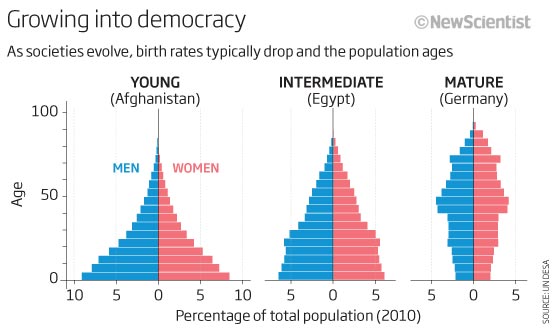
Demographer Richard Cincotta of the Stimson Center in Washington DC has compiled some intriguing facts about revolution and the age of populations. His analysis not only enables him to predict if a revolution will occur in a particular country but whether or not a revolution will transition into a democracy.

Studying oppressive autocracies around the world in the period 1972 to 1989, he found that if their median population age was over 35, they were unlikely to be subject to revolution at all. Of those that experienced revolutions when their median age was between 30 and 35, all are still democracies today. Ninety per cent of those with a median age less than 25 ultimately reverted back to oppressive regimes. With median ages between 25 and 30, they could go either way.

So what does this mean for the Arab Spring countries? Well, Tunisia, with a median age of 30, is the most likely to transition to a permanent democracy. With median ages of 25 and 26 respectively, Egypt and Libya have a chance, but for Syria and Yemen, at 21 and 17, the odds are very poor indeed.

As for the country we are most invested in—Afghanistan—with a median age of 18, a permanent transition to democracy may be a long time coming.

Although age appears to be a useful indicator for stable transitions, it is not likely a cause. That is more likely reflected by the maturity of a country. More mature, complex societies—urbanized, high income, greater gender equality, better educated, etc.—are more equipped for democracy and also have lower birth rates and therefore older populations.

Older generations often say that youth is wasted on the young. In the case of revolution, it would seem to bear a kernel of truth.

16 May 2012

Egyptians still want democracy ... and sharia

Since the Arab Spring of a year ago, support for democracy in Egypt has remained strong according to a recent Pew Research Center survey. Most Egyptians remain optimistic about the future and two-thirds prefer democracy over any other form of government.

As support for democracy remains strong, so does support for Islam. The most popular political organization is the Muslim Brotherhood with 70 per cent of Egyptians expressing a favourable view. (The April 6th Movement, composed largely of the young, secular activists involved in the demonstrations, is considered favourably by 68 per cent.) Along with strong support for the Brotherhood, most Egyptians believe the Koran should shape the country's laws.

Perhaps surprisingly, the military is also still well-regarded. Three-quarters of Egyptians believe it is a good influence and almost two-thirds think positively of the ruling Supreme Council of Armed Forces.

The continued support for democracy is encouraging. However, it does not include separation of mosque and state, and that is not so encouraging. Nor is support for the military in a country that has been ill-used by military men in the past. The progress of Egypt, the most important state in the Arab world, remains an engaging drama.

12 May 2012

Can Canada not protect its workers from foreign predators?

That the new global economy is a corporate construction is not in doubt. It is arranged to benefit investors and employers, not employees. Canadian and American companies can freely enter Mexico to exploit cheap labour but Mexican workers cannot freely enter Canada or the U.S. to exploit higher wages. It's a one-way street.

And of course not only Mexicans are open to predation. U.S.-based Caterpillar Inc. waltzed into Canada, bought a factory, stripped it of its assets, humiliated the workforce, and waltzed back home to the U.S. A raid carried out with almost military precision and the Canadian government never raised a hand to defend its citizens.

Now the U.S. giant Target has bought out Zellers and up to 13,500 employees will lose their jobs. Many will be re-hired to work for Target but with no guarantee they will be offered more than starting conditions.

We do have the Investment Canada Act to protect us from foreign investments not in our interest. The Act states that "A non-Canadian shall not implement an investment ... unless ... the Minister is satisfied ... that the investment is likely to be of net benefit to Canada." However "net benefit" is narrowly applied and buyouts only occasionally rejected.

As for Target's purchase of Zellers, it is difficult to see how this is of advantage to Canadians in any way. Messing about with thousands of workers as if they were chattel would seem to work very strongly indeed against "net benefit."

How the lords of the universe treat their employees should be of critical interest in assessing their net benefit to this country, including whether they respect basic human rights such as freedom of association. In 2010, the government rejected a proposed buyout of PotashCorp on the basis that it is a key strategic asset for Canada. It seems to me that workers are rather more of a strategic asset than potash. But then our government does seem to favour commodities over people.

11 May 2012

Obama jumps in front of the parade

Political leadership has been defined as figuring out where the people are going and then getting in front of them. If that's the case, American President Barack Obama is clearly showing leadership with his support for gay marriage.

A recent Pew survey showed that support for gay marriage in the U.S. has jumped from 31 per cent to 47 per cent since 2004 whereas opposition has dropped from 60 per cent to 43 per cent. Perhaps most telling is the change in "strong" support. The number of Americans strongly supporting gay marriage has double from 11 per cent to 22 per cent while the number strongly opposing has fallen from 36 per cent to 22 per cent.

Even the older generation is changing its mind. Opposition to gay marriage among the over-65 group has dropped from 74 per cent to 56 per cent in the last eight years.

The parade toward acceptance of gay marriage in the U.S. is well under way. President Obama has wisely jumped in front.

09 May 2012

Why poor Americans vote Republican

One of the mysteries of American politics is why so many of the poorer, government-dependent jurisdictions vote for the party that pushes for smaller government and reduced social programs. An article in the May issue of the New Internationalist offers an explanation. The article points out that, for example, the county where per capital food stamp payments are the highest in the U.S.—Owsley County, Kentucky—votes overwhelmingly Republican. States such as Mississippi, Arkansas and Tennessee, where residents on average get the highest portion of their income from government supports, are also solidly Republican, the party of the rich.

One reason may be that they are Bible Belt states whose people are more swayed by moral issues than economic ones. They vote, therefore, for whoever is most opposed to gay marriage and abortion rather than for whoever most supports assistance for the poor.

Another reason is political illiteracy. A study by Cornell University professor Suzanne Metler showed that 40-44 per cent of people receiving Social Security, unemployment benefits or Medicare insist they have not used a government program. This resounding ignorance was epitomized by an elderly gentleman who, at a town hall meeting about Obama's health care legislation, shouted, "Keep your government hands off my Medicare." Medicare, a federal program of health care for the aged, is one of the nation's most successful and popular institutions.

This disconnect between reality and ideology works powerfully against achieving a more equitable society, the best guarantee of a healthy society. It does, however, work wonders for the Republican Party, a testament to their highly effective campaign of government-bashing.

08 May 2012

Coming home: Khadr vs. Black

One Canadian and one former Canadian have wanted very much to come home to this country. Both are convicted felons—one, Omar Khadr, remains incarcerated at Gauntanamo, Cuba, the other, Conrad Black, has been released and is now back in his house in Toronto. Both cases have been hotly debated, but while the federal government has done everything in its power to delay Khadr's homecoming, Conrad Black slipped into Canada with ease.

A superficial look at the charges they have been convicted of would seem to justify the federal government's position on the two cases. Convicted of fraud and obstructing justice, Black's crimes pale in comparison to Khadr's convictions of murder and aiding terrorism.

It is not, however, quite that simple. Khadr, a classic child soldier, should never have been charged with anything. Furthermore, while Black received a fair trial, Khadr was subjected to the drumhead justice of a military tribunal and took a plea bargain to escape almost certain life in prison if not a death sentence. Comparison of the crimes is not, therefore, so much between fraud and murder as between guilt and innocence.

In addition, while Khadr is a Canadian citizen, and therefore deserving of our protection, Black contemptuously dismissed his Canadian citizenship in favour of the British version complete with lordship. He is both a convicted felon and a foreigner.

On balance, the stronger case for accepting these two back in our bosom rests with Khadr. The Canadian government would seem to disagree.

05 May 2012

Would 42 months in prison make Harper a better Prime Minister?

I assure you that the title of this post is purely tongue-in-cheek. Heaven forbid I would want to see Stephen Harper behind bars. Nonetheless, another prominent conservative just spent 42 months in the slammer and he emerged a better man with a better sense of what prison can and cannot do for society.

Conrad Black, formerly inmate no. 18330-424 in the U.S. federal prison system, has returned to Canada by his own account “a humbler, more sensitive person.” No small admission from a man of Black's arrogance, he credits his new-found humility and sensitivity to his incarceration, particularly his association with members of society less fortunate than he.

Furthermore, he has become a critic of the American prison system and, more importantly, of the Harper government's borrowing of some its worse aspects for Canada's new criminal justice law. For example, on mandatory minimum sentences, a favourite of the Harper regime, he has this to say, “Unfortunately, like archaic cultures that clung to the belief that the Earth was flat, those who support mandatory minimum sentences for drug crimes are willfully ignorant of the near universal consensus that mandatory minimum sentences are both extremely costly and ineffective ... it will be a sad legacy for Canadian conservatives if we sit quietly and ignore how U.S. society has been remarkably weakened by the same laws our government is now hell-bent on enacting.”

His overview of the American legal system is devastating: “The American justice system has become a gigantic legal cartel where there are too many laws and the legal profession is a terrible taxation on the country ... The country has become a carceral state detaining an obscene number of its own citizens, and a vastly disproportionate number of the world’s prisoners, often in conditions that are shocking especially in such a rich and generous-minded country, so proud of its humanitarian traditions.”

At times, Black's critique cuts a wider swath through American society, the society Mr. Harper seems to want to emulate. Listen to Black on the circumstances of his fellow inmates: "Many are victims of legal and social injustice, inadequately provided for by the public assistance system, and over-prosecuted and vengefully sentenced. The greater competitiveness of the world makes the failures of American education, social services and justice unaffordable, as well as repulsive. In tens of millions of undervalued human lives, as in the consumption of energy and the addiction to consumer debt, the United States pays a heavy price for an ethos afflicted by wantonness, waste and official human indifference." Strong stuff—Mr. Black has not lost his rhetorical flair.

I have never paid much attention to Conrad Black's opinions, but in this case I must concede he has inside knowledge. Literally. Now if he could only transmit some of his insight into what would make for a more humane, financially-sound penal system, to say nothing of his new-found humility and  sensitivity, to our Prime Minister, we would all benefit.

03 May 2012

I paid how much?


02 May 2012

Rupert Murdoch unfit for journalism

A British parliamentary panel has concluded that press lord Rupert Murdoch "is not a fit person to exercise the stewardship of a major international company." They might equally have said he is not a fit person to exercise stewardship over journalism. The sleaze that has been revealed in Murdoch's media empire is a direct result of the amoral nature of the man's character. Labour MP Tom Watson, himself a target of phone hacking by Murdoch's goons, stated, "It is his company, his culture, his people, his business, his failure, his lies, his crimes, the price of profits and his power."

To Murdoch, profits and power are everything. Journalistic standards—honest reporting and fair analysis—are irrelevant. The man hasn't even had the integrity and courage to accept the blame for his corporation's misbehavior. He has, in typical weaselly fashion, blamed subordinates, who in turn blame their subordinates—very much the Murdoch culture.

He has not only corrupted British journalism but, much more importantly, he has corrupted British democracy—sadly, with assistance from allies at the very top of the British political establishment, including Margaret Thatcher and Tony Blair. With his power to make or break governments, prime ministers genuflected before this wizened oligarch like worshipers before their God.

Murdoch follows in the tradition of too many press lords going back to William Randolph Hearst whose ability to make lots of money is incompatible with higher moral purpose. And higher moral purpose is what journalism ought to be all about.

The panel's report will now be considered by the House of Commons. The British government has a heavy duty, first to establish respect for British journalism, and second to protect British democracy from oligarchic media. Strong measures will be required. Will a Conservative Prime Minister have the stomach to take strong measures against the interests of an oligarchy? Will minority government force his hand? This is an issue to be followed closely.

28 April 2012

Wildlife flourishes in human dead zones

We all know what the big problem with planet Earth is—people. Homo sapiens. The most destructive of species. Ever since we walked out of Africa 70,000 years ago, we have been an enemy of nature. Long before we invented agriculture, we were annihilating other species. The only big land animals left on Earth, live in Africa because they evolved with us and learned to survive our aggressive ways. Everywhere else, from Madagascar to Europe to the Americas to the Antipodes, we annihilated the megafauna as we encountered it. When we invented agriculture, we declared war on entire ecosystems, turning lush plains and forests into deserts wholesale.

It is no surprise then that when we are eliminated, nature flourishes. Such is the case in the demilitarized zone (DMZ) between North and South Korea. This 1,000 square kilometre area that wanders across the peninsula is a no-go zone for humans but has become a paradise for other animals.

From the Japanese occupation of 1905 to 1945, when radically increased exploitation of mineral and other resources brought dramatic environmental decline, to the Second World War to the Korean War, the natural world of the peninsula has been savaged by human violence. Continuing deforestation for fuel and clearing for agricultural land combined with unrestrained industrialization has further undermined the region's ecological health. Established in 1953, the DMZ has allowed nature to recover and the green strip now stands in stark contrast to the failing ecosystems that border it north and south.

It is home to thousands of plants and animals that are extinct or endangered elsewhere on the peninsula. One hundred species of fish, 45 types of amphibians and reptiles, over 1,000 insect species, 1,600 types of vascular plants and more than 300 species of mushrooms, fungi and lichen are believed to exist in the zone. Included are the rare Amur goral, Asiatic black bear, musk deer and even tigers, believed extinct in Korea since before the Japanese occupation, have been reported.

Similarly, wildlife in the area surrounding the infamous Chernobyl nuclear power plant in Ukraine appear to be doing very nicely despite the explosion and its aftermath, apparently surviving radiation better than they survive humanity. According to University of Portsmouth Professor Jim Smith, "The wildlife populations in the exclusion zone around Chernobyl have recovered and are actually doing well and even better than before because the human population has been removed." Local scientists have reported large increases in wildlife populations since the accident. Rare species such as lynx, Przewalski's horses and eagle owls are thriving.

The message is clear: For a healthy planet, exterminate its biggest pest. Such is the judgement on our stewardship of the Earth.

25 April 2012

Co-operatives—the proven alternative to capitalism

In this, the International Year of Co-operatives, we cannot remind ourselves too often of the tried and true alternative to conventional capitalism. Co-operatives have for generations offered a more humane approach to economic activity than competitive enterprise, even while competing successfully in a capitalist marketplace. They have provided a full range of economic services at the local, national and international levels, combined with social benefits absent from capitalism.

The greatest benefit is that they are democratic institutions—one member/one vote—as opposed to capitalist corporations—one share/one vote, a classically plutocratic arrangement. By providing equitable investment in the economy and reducing the excessive influence of wealth in society, they answer the Occupy Movement's two concerns about corporate power. They help create community locally, nationally and internationally. They are amenable philosophically to both left and right—they are capitalist in the sense that ownership is private but socialist in the sense that ownership is equitable.

Their capacity for success is illustrated nicely by the Calgary Co-operative Association. Principally involved in supermarkets, the Co-op also provides service stations, home health care, pharmacies, travel agencies and liquor stores. It has 440,000 members—40 per cent of the city's population. All its employees are member-owners, sharing power equitably with the customer-owners.

Needless to say, I am a long-term member. I buy almost all my groceries there as well as my booze and gas for my car. I round out my co-operative experience by doing all my banking at First Calgary Financial, the city's major credit union. Going co-op to the max is my way of helping to build a more humane and democratic economy.

The co-operative is here, and it works at every level. Globally, one out of five people are already members of co-ops. We need look no further for an answer to capitalism with its inequities and its insults to democracy. By maximizing our own economic relationship with co-ops and pushing our governments to favour co-operative enterprise over competitive enterprise, we can replace the misguided mantra "we must compete in the global economy" with the more civilized "we must co-operate in the global society."

24 April 2012

Albertans reject retreat

During her concession speech last night, Wildrose Party leader Danielle Smith stated that Albertans just needed more time to get to know her party. In fact, that was why Wild Rose lost so surprisingly—Albertans got to know her party.

Midway through the campaign, Wildrose was sailing. At 40 per cent in the polls, majority territory, it appeared Albertans were indeed in the mood for a change of party, the first in over 40 years. And then voters took a closer look at what kind of change Wildrose represented—and decided they did not want to go there. The fresh young face of Danielle Smith, a bright and vivacious woman, was hiding the reality of old-time fundamentalist Alberta—Social Credit freshly packaged. Albertans are an urban people now—two-thirds live in Calgary and Edmonton—and have no interest in returning to rural values. Indeed, as I have blogged previously, they are rapidly developing more progressive views on social issues.

Wildrose's roots were apparent in the election results. Out of the party's 17 seats, only three were urban—two in Calgary and one in Medicine Hat. Even the smaller, more conservative cities of Red Deer and Lethbridge went PC. As the campaign progressed, Smith had an increasingly difficult time concealing the party's fundamentalist core and spent the last week trying to whack-a-mole her reactionary candidates.

Premier Redford also promised change, and she is indeed a refreshing change from the Klein/Stelmach years. We are now about to see how Progressive her Conservatives are.

21 April 2012

Dumbing down Canadians

It started, perhaps, with the Economic Council of Canada. The Council, a Crown Corporation whose role was to conduct a wide range of economic and policy research for the federal government, provided Canadians with an objective analysis of economic affairs. In 1992, Brian Mulroney, furious over a Council report that said Quebec separation might not have the dire consequences his government predicted, shut it down. Mr. Mulroney did not want certain inconvenient facts before the public.

Our current Prime Minister's distaste for facts goes well beyond Mr. Mulroney's. Demographic analysis increasingly shows that equitable societies are healthy societies, a fact antithetical to the Conservative fetishes for capitalism and privilege. So out went the mandatory long-form census.

Indeed, social inequality is not something Mr. Harper's government wants to hear a lot about, so the National Council of Welfare has now been scrapped. The Council in effect acted as the country's conscience, identifying areas of poverty, providing appropriate information to the government and bringing social policy thinkers together to develop solutions. It provided citizens, particularly low-income citizens, and NGOs the facts they needed to speak out effectively about poverty, facts that may no longer see the light of day.

Nor does the PM think too much knowledge about climate change is good for us. Facts in this area tend to conflict with the agenda of the Conservative/Oil Industry coalition. So the Polar Environment Atmospheric Research Lab is closed (global warming is particularly pronounced in the north), the National Roundtable on the Environment and the Economy is shut down, environmental reviews of major projects will be "streamlined," and so on.

Indeed, science itself often produces too many inconvenient facts for the growth at all costs policies of this government, so its scientists are routinely muzzled. And National Research Council funding that once might have supported pure scientific research will now be handed over to private companies. One suspects that energy and mining companies will be high on the priority list.

And then there's the recent budget assault on the CBC, the only national mass medium in the country not owned and controlled by the corporate sector. The Harper administration prefers to have the dissemination of information safely in corporate hands.

Citizens of a democracy need sources of information independent of vested interests—governments, political parties, and corporate agents—in order to make informed decisions. Universities and other non-profit groups need objective information to participate effectively in analysis and policy formulation. Lacking the expertise and the funding to conduct their own independent research, and confronting an increasingly complex world, citizens rely heavily on institutions like those mentioned above. A fundamental responsibility of democratic government is to ensure that citizens have the information they need.

The Harper government clearly has no intention of fulfilling this responsibility. It prefers to leave Canadians dependent on corporate institutions such as the daily press, PR firms, and right-wing think tanks. Facts, and indeed entire issues, in which these agents have little interest or outright antipathy can be conveniently massaged or simply ignored. The result is a citizenry more indoctrinated than informed. And that, I fear, is the direction we are headed.

19 April 2012

Will the Fraser Institute be audited?

Now that the federal government has allocated $8-million for the auditing of charitable groups ostensibly to ensure they stay within the Charities Act, one naturally wonders if this will include all charities or be limited to environmental groups, the bête noire of the Conservative/oil industry coalition.

The Fraser Institute is a case in point. Although having charitable status, it serves principally as a propaganda vehicle for right-wing views. It is funded by corporations and other business interests, including business-oriented charitable funds such as the Donner Canadian Foundation, a group controlled by the American Donner heirs. It has been referred to as the "lifeblood of conservative research" in Canada.

An audit of the Fraser Institute would be in order for a number of reasons. For instance, to ensure its work is primarily educational as it claims or primarily political propaganda which it more closely resembles. Also, the public should know just which corporations are insinuating themselves into our "democratic" process by funding the Institute, particularly if they are foreign corporations. This, at a time of increasing corporate influence in society, is almost as important to know as which corporations are contributing to political parties. And do contributions from American-controlled charitable funds such as the Donner Foundation meet the requirements of the Charities Act?

These are important questions. I await the audit.

18 April 2012

The Monroe Doctrine is dead

A new age has dawned in the Americas. The Monroe Doctrine, a policy established by the United States ostensibly to keep European imperialists out of the Western Hemisphere but which eventually deteriorated into an instrument to maintain American dominance, is now effectively deceased. At the recent Summit of the Americas, the Latin nations couldn't have made it clearer that they intend to be treated as equals. On two key issues—Cuba and drugs—the United States was effectively isolated, except of course for Canada. The Americans insist on pursuing the drug war and precluding Cuba from summit meetings in the face of solid opposition from the other OAS members.

Particularly interesting was the prominent position played by Colombia, host of the summit, in emphasizing the two issues. It has been the Americans' chief supporter in Latin America in recent years, including on the drugs portfolio. When Colombia challenges the United States, something important is happening.

A number of developments have contributed to the American decline in commercial and political influence in the region: the rise of regional powers such as Brazil and Mexico, gains made by China as a leading trade partner, the successes of the South American left, and the rejection of the free trade agreement proposed by the U.S. in favour of agreements more suitable to the economic and social interests of the Latin nations.

At the last summit, President Obama spoke of "equal partnerships" and "a new chapter of engagement" with the region's countries. He promised the U.S. would "take aggressive action to reduce our demand for drugs, and to stop the flow of guns and bulk cash across our borders." Yet little has changed in American policy or practice. They continue to pursue an aggressive "free trade" agenda; they have escalated militarization in the "war on drugs"; and they persist with cold war policies of containing left-wing governments.

If the United States wants to maintain a credible role in the hemisphere, never mind a leadership role, it will have to be more accommodating to the views of the Latin nations. It might also offer its Secret Service agents a quick course on how to deal tactfully with booze and hookers when on international missions. And President Obama might say ten times before breakfast—it's the Malvinas, not the Maldives.

13 April 2012

Albertans—more progressive than conservative

As Albertans face an election later this month and the Conservative Party is seriously challenged by an even more conservative party, the Wildrose Party, we might stop for a moment and ask just how conservative Albertans really are. If the question pertains to social conservatism, the answer is not very.

Last November, a survey taken in Lethbridge by the Citizen Society Research Lab at Lethbridge College, indicated Albertans are a lot more socially progressive than they are socially conservative, and rapidly becoming more so. For example, 82.7 per cent of respondents favoured abortion choice, up from 73.3 per cent just two years ago. Even a majority of the "very religious" supported abortion choice. Gay marriage was supported by 69.6 per cent, up from 58.3 per cent two years ago. Doctor-assisted suicide was supported by 70.2 per cent. Lethbridge seems to have progressed well beyond its one-time reputation as a Bible belt city. Surveys in Calgary and Edmonton show even higher numbers on the progressive scale.

Quite aside from all the stats, in the last municipal election Calgarians chose the very progressive Naheed Nenshi as mayor. (I will tactfully avoid mentioning who Toronto elected.) And, of no small significance, the leaders of the two leading political parties are both women, so regardless of the election outcome we will have a woman premier.

It would seem that socially at least, Alberta is a rather progressive place. Now if we could just get over that addiction to dirty oil.

I know more about American political parties than 92 per cent of Americans

Don't take my word for it. The Pew Research Center says so. All I did was take their quiz about the two major American political parties and answer all the questions correctly. And that put me ahead of 92 per cent of Americans surveyed by the Center.

Take the quiz yourself. It's at http://pewresearch.org/politicalquiz/?src=prc-newsletter. You, too, may be "more news-savvy than the average American."

11 April 2012

The Mary Jane debt solution

The Spanish village of Rasquera is 1.3 million euros in debt, and with Spain's battered economy, not much relief in sight. Until now. This week, Rasquera held a referendum and the villagers voted 308 to 239 to rent land for growing marijuana.

Although trafficking remains illegal in Spain, growing cannabis for personal use isn't. Apparently the Barcelona Personal Use Cannabis Association (ABCDA) is prepared to pay the village 650,000 euros a year for the right to grow its annual supply there. At that rate, Rasquera could pay off its debt in a couple of years, a tempting offer indeed.

Considering that most pot smokers are youth, it may be unfair to ask them to pay off the village debt when they are already suffering from high unemployment. However, the ABCDA will no doubt get its dope somewhere, it may just as well be from Rasquera. And nothing like a joint or two to relieve the pain of unemployment.

The idea sounds win-win to me. The members of ABCDA get their high and the citizens of Rasquera get their debt paid off. Is there something here for Canada to ponder? It certainly beats building more prisons.

Baseball and that freedom of speech thing

Sports is a tribal business, and Miami Marlins manager Ozzie Guillen has upset his tribe. The outspoken Venezuelan had the audacity to express admiration for Fidel Castro in Time magazine. “I respect Fidel Castro,” he is reported to have said. “You know why? A lot of people have wanted to kill Fidel Castro for the last 60 years, but that motherfucker is still here.” The team and a number of the fans objected to his comments and the now contrite Guillen will apologize for his reckless exercise of freedom of speech. In the meantime, he has been suspended for five games.

In its statement, the Marlins declared there was nothing to respect about Fidel Castro. That of course isn't entirely true. Castro liberated Cuba from the criminal dictatorship of Fulgencio Batista and his Mafia partners who had plundered the country for years. And Cuba has built easily the best health and education systems in Latin America, better in some respects than those in the United States, no small accomplishment for a country heavily embargoed.

Nonetheless, the country remains a dictatorship and expressing  respect for Fidel is probably not the most prudent move in Miami-Dade County, the Marlins' home base, a jurisdiction 34 per cent Cuban-American. And yet, Guillen was right—despite the best efforts of the CIA to kill the old motherfucker, he's still there. That does deserve a little respect. As does freedom of speech.

04 April 2012

Marriage one man/one woman? Not in the Bible

Although gay marriage seems to have settled into acceptance in this country, it still meets with virulent opposition elsewhere, including in the United States. Certain of the candidates for the Republican presidential nomination serve as good examples. Strutting their Christian credentials, they loudly proclaim their mantra, "Marriage means one man and one woman."

Their credentials do not, however, seem to include knowledge of the Bible. Far from one man and one woman, the Biblical prophets were more inclined to one man and many women. For example, Abraham, father of the Hebrew nation, had three, a piker however compared to David, first king of Israel, who had at least eight, plus 10 concubines for those days when he was feeling exceptionally randy. Moses, bearer of the tablets, only had two, but Solomon had 700 wives and 300 concubines. Reputedly the world's wisest man, he may also have been its most libidinous. Jacob, father of the twelve patriarchs of the tribes of Israel, was clearly a man of more modest appetites, limiting himself to four wives. Marriage as one man, one woman? These lusty buggers would have laughed you out of the room.

The nuclear family—one man, one wife and children—adopted by Christianity probably came about because the religion was created within the Roman Empire which, drawing on European customs, had a tradition of monogamous marriage. The Muslim faith, truer to Middle Eastern custom and therefore to the Bible, still allows polygamy.

So when Christians fundamentalists trot out their marriage means one man and one woman mantra, we might tactfully suggest they read their Old Testament and refresh their fundamentalism.

03 April 2012

Americans increasingly support interracial marriage

At a time when Americans agonize over the shooting of Trayvan Martin in Florida, and racial tensions simmer, a Pew Research Center survey reveals at least one encouraging development. According to the survey, 43 per cent of Americans believe the national rise in interracial marriage is a change for the better while only 11 per cent believe it is a change for the worse. Forty-four per cent think it makes no difference.

Not surprisingly, support for interracial marriage increases with youth. Sixty-five per cent of the 18-29 age group see it as a good thing while only five per cent do not. Among those over 65, only 28 per cent are positive about interracial marriage. However, considerably fewer—19 per cent—view it negatively.

The survey indicates the U.S. is a rather more racially tolerant country than the Trayvan Martin incident might indicate. Americans still have a ways to go to overcome their ancient nemesis, but they seem headed in the right direction.

02 April 2012

My two cents on Calgary's Peace Bridge

It's finally done. Over budget and overdue, but it's done. One of the most controversial pieces of infrastructure in Calgary's history, the Peace Bridge, a pedestrian walkway over the Bow River, is finally open for traffic.

I am a strong supporter of the compact city as a more efficient city, both financially and economically, and that means I am a strong supporter of promoting pedestrian traffic and public transit use over cars. But that doesn't mean I support any and all pedestrian amenities, and the Peace Bridge I do not.

In the first place it is, as so many people have pointed out, a bridge from nowhere to nowhere. At the north end it launches itself from a bicycle path in the middle of a block. The local alderman is now desperately consulting with her constituents to figure out how to get pedestrians safely across the busy 4-lane street (Memorial Drive) that borders the path—an exercise rather late in the day. As for who will use the bridge, the Sunnyside embankment limits the source of commuters to a very small area.

And that brings me to my next point. Only two blocks west, there are three pedestrian bridges—one on either side of the Louise Bridge and one under the C-train overpass. In other words, the Peace Bridge is quite unnecessary. A number of locations in the city offer a much better opportunity for a bridge or crossover that would encourage pedestrian traffic and public transit use.

Aesthetically, the bridge is alien to its environment. It reflects none of the forms, colours or materials of the Bow River Valley in its design. It is a pretty, sparkly thing in its own right but it is out of context—a sort of magpie architecture. It manifests one of greatest sins of the architectural profession. Architects design structures that are handsome in themselves but don't fit into their neighbourhood. This bridge has been defended on the basis that it is a work of art that will help make Calgary a great city. Perhaps, but it tends more to make Calgary look like a city with insecurities, desperate to prove it is in the big leagues.

The bridge doesn't just sin against its environment, it sins against the citizens of Calgary. With cavalier disregard for the taxpayers' dollar, and in violation of city policy, the design was selected without a competition. Although Calgarians may not have the refined artistic sensibilities of transportation department officials, it is their bridge after all and they might have been offered an opportunity to express their views.

This sort of arbitrary process undermines peoples' faith in their government. Government-bashers have been offered a very big stick to beat City Hall with and they are taking full advantage. Almost every rant about big government and high taxes you hear in Calgary these days starts off with the Peace Bridge. I fear the bridge will make it more difficult to provide truly worthwhile pedestrian amenities in the future, doing a great disservice to our city.

Some of the points supporters of the bridge have made, I heartily agree with. For example, that the $25-million spent on this bridge would hardly have earned a whimper of protest if it had been spent on a freeway or an interchange. I agree also that public infrastructure should have aesthetic appeal. Of course it should. But these are general considerations—they don't justify an ill thought out piece of infrastructure.

In any case, it is done and we are stuck with it. Now we must consider what we can learn from it. A number of things actually. First, always, except in exceptional circumstances, subject projects to competition. Second, consult the public early, not after the fact. Third, design for the context. And finally, don't be governed by our insecurities—Calgary doesn't need baubles to make it a great city.

If we are to build the compact city, we must be jealous guardians of the public purse. The public will not be dissuaded from urban sprawl if they see amenities for pedestrians and public transit users linked to financial recklessness.